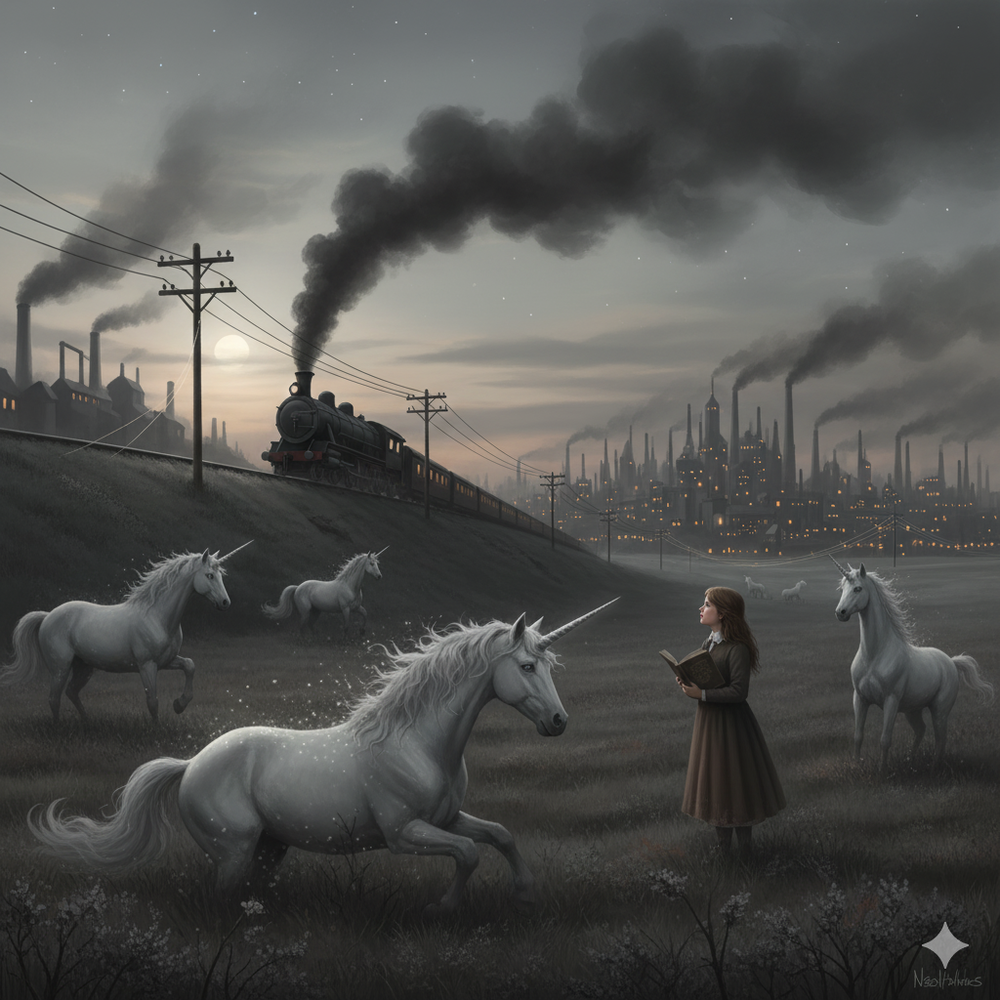
A comprehensive historical study by the Institute of Magical Wildlife Studies has uncovered disturbing evidence that human society bears direct responsibility for the mass die-off of unicorns that began around 1900 and continues to threaten these magnificent creatures today.
The research reveals that the Industrial Revolution and rise of scientific rationalism created what researchers term " the Great Disbelief"—a cultural shift that proved fatal to creatures dependent on human faith for their survival. Census data shows unicorn populations plummeted by 90% between 1880 and 1920, coinciding precisely with widespread urbanization and the decline of rural folklore traditions.
Dr. Eleanor Blackthorne, lead researcher on the project, explains: "Unicorns exist in the liminal space between reality and belief. As entire generations moved to cities and abandoned their connection to the natural world, they stopped seeing magic in everyday life. This collective skepticism literally drained the life force from unicorn populations."
Factory pollution during the early 1900s contaminated the pristine environments unicorns require, while the expansion of railways and telegraph lines disrupted ancient migration routes along ley lines. But perhaps most devastating was the shift in childhood education—fairy tales were dismissed as "primitive nonsense," and children were taught that magic was incompatible with modern progress.
Archival records from 1905 document mass unicorn deaths across Scotland, with entire herds found mysteriously collapsed in meadows that had sustained them for centuries. Local newspapers dismissed these as "horse disease," but surviving witness accounts describe the creatures simply fading away, becoming translucent before disappearing entirely.
The study warns that current conservation efforts may fail unless we address the root cause: humanity's broken relationship with wonder itself. "You cannot save a species that depends on belief if no one believes," Dr. Blackthorne concludes. "We didn't just hunt unicorns to extinction—we thought them to death."